
Federal Housing Program Guide
As Congress approaches the end of the federal fiscal year on September 30th, housing advocates, developers, and service providers are watching closely for what’s next. New Hampshire receives over $315 million in federal housing-related funding for direct rental assistance, capital development, and homeless services.
This report compares the current federal budget proposals, summarizes key federal programs, and looks at the impact those programs have in New Hampshire. This is not an exhaustive look at every federal housing dollar that comes to New Hampshire, but it provides a baseline understanding of how the federal budget impacts access to a home for thousands of Granite Staters.
The vast majority of dollars appropriated to New Hampshire for housing purposes come via the Department of Housing and Urban Development (HUD) and the United States Department of Agriculture (USDA). Outside of New Hampshire’s largest cities, communities are eligible for USDA Rural Development programs.
The table below compares the FY 25 federal budget (a full-year continuing resolution signed on 3/15/25) with the President, House, and Senate budget proposals. The HUD data was collected by the National Low Income Housing Coalition and the USDA data was collected by the Housing Assistance Council.
Rental Assistance
Introduction: Rental assistance is among the most critical tools the federal government uses to prevent homelessness and make housing affordable for low-income families, seniors, and people with disabilities. According to the Center on Budget and Policy Priorities, there are 40,300 Granite Staters utilizing federal rental assistance programs to afford modest housing. 80 percent of those utilizing federal rental assistance are seniors, children, or people with disabilities.
These programs overwhelmingly support working families. 79 percent of non-disabled, working-age New Hampshire households receiving Department of Housing and Urban Development rental assistance include at least one worker.
As you can see in the chart below, the two largest programs in New Hampshire are Housing Choice Vouchers and Section 8 Project Based Vouchers.
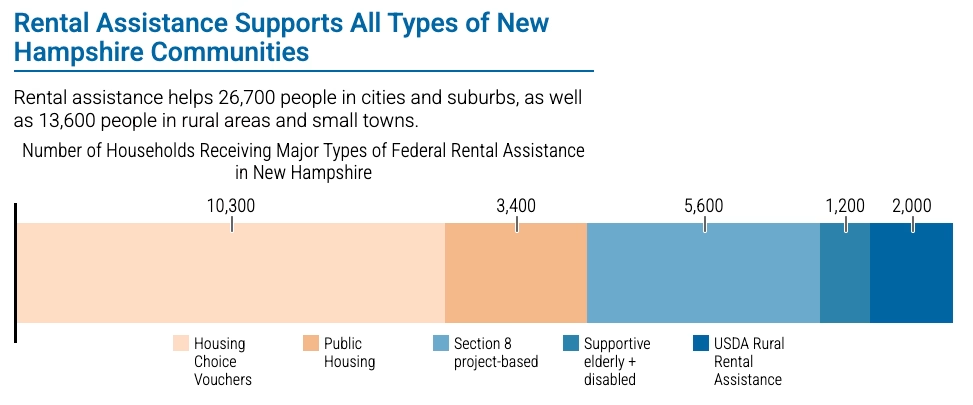
You can review and download the Center on Budget and Policy Priorities New Hampshire factsheet here.
Key Rental Assistance Programs:
Housing Choice Vouchers (HUD): HCVs are the largest federal rental assistance program, helping low-income families, seniors, and people with disabilities afford housing in the private market. HCVs are administered by local Public Housing Agencies and/or New Hampshire Housing. The HCV pays a portion of the rent directly to the landlord and the tenant pays the balance. However, there are limits as to how much of their income a tenant can pay while using a voucher. While this is designed to protect the tenant, the HCV plus the tenant limit is often below the market rate, meaning that even those who are awarded vouchers, often struggle to find places they can afford. New Hampshire also allows landlords to discriminate based on source of income, which means landlords can deny an otherwise qualified applicant solely based on their status as a HCV holder. New Hampshire receives approximately $130 million in Housing Choice Voucher funds per year.
Project-Based Vouchers (HUD): PBVs are the second largest federal rental assistance program in New Hampshire. The key difference between HCVs and PBVs is that HCVs are tied to the person while PBVs are tied to the project. Qualified tenants pay 30 percent of their income for rent and utilities, and the balance is paid through a contract with HUD using the PBV funds New Hampshire receives approximately $82 million in Project Based Voucher funds per year.
Section 521 Rural Rental Assistance (USDA): The Rural Rental Assistance program at USDA provides project based rental subsidies to tenants in Section 515 properties who have low and very-low income. Similar to the Project Based Vouchers through HUD, these subsidies cover the difference of 30 percent of a tenant’s income and their monthly rent. Historically, Section 521 Rental Assistance was available only to tenants who are living in Section 515 USDA Rural Rental Housing Loans (more on this below) properties. The problem is that when those mortgage loans expired, the rental assistance did as well. This coupling of 515 and 521 jeopardized the housing for all the low and very-low income tenants. In recent years, USDA has gained the authority to offer standalone rental assistance and continues a pilot program that decouples the Section 515 and 521 programs. New Hampshire receives approximately $14 million in Section 521 Rental Assistance each year.
Section 202: Housing for the Elderly and Section 811: Housing for People with Disabilities (HUD): Provides affordable housing and supportive services for very low-income seniors (202) and people with disabilities (811) to help them live independently in the community. New Hampshire receives approximately $1.7 million per year across these two programs.
Affordable Housing Development
Increasing the overall production of affordable and attainable housing is the long-term solution to our housing shortage. However, below-market-rate housing is very difficult to build without a capital investment. From flexible block grants to tax credits and trust funds, federal housing development programs help communities build and preserve homes for those who need them most.
The Nation Housing Preservation Database mapping tool tracks affordable rental properties. You can use this tool to search for affordable housing options within a region and filter by the federal program that made the development possible.
Key Affordable Housing Development Programs:
HOME Investment Partnership Program (HUD): The HOME program is a federal affordable housing block grant program. The program provides grants to states and qualifying local governments to fund a range of housing activities including construction, rehabilitation, and preservation of housing for rental or homeownership. HOME funds can also be used for direct rental assistance, security deposits, or other eligible uses. The funds are required to meet certain affordability restrictions to ensure the benefits are going to low- and moderate-income individuals. HOME funds are often combined with other sources of capital subsidy since they are not enough, on their own, to develop new housing. New Hampshire receives approximately $5 million per year in HOME Investment Partnership Program funds with New Hampshire Housing, Manchester, and Nashua all receiving HOME funds.
National Housing Trust Fund (HUD): The Housing Trust Fund provides funding to states to help build, preserve, rehabilitate, and operate housing affordable to people with the lowest incomes. In New Hampshire, New Hampshire Housing receives the Housing Trust Fund dollar. New Hampshire receives approximately $3.1 million per year in HTF funds. You can read more about the Housing Trust Fund in this National Low Income Housing Coalition factsheet.
Community Development Block Grant (HUD): The CDBG program is a flexible federal grant program administered through HUD that provides communities with funding to develop community and economic projects, improve housing, create public facilities, and provide public services, with a focus on benefiting low- and moderate-income people. CDBG funds support a range of activities, such as housing rehabilitation, infrastructure improvements, and job creation initiatives, and are awarded to state and eligible local communities. New Hampshire receives approximately $13 million with the New Hampshire Community Development Finance Authority administering the majority of the funds statewide. Dover, Manchester, Nashua, Portsmouth, and Rochester all receive CDBG funds as qualified local entities.
Section 515 Rural Rental Housing Loans (USDA): The Rural Rental Housing Loans program provides direct, long-term, low-interest loans from the USDA to non-profit and for-profit developers to finance affordable rental housing in rural areas. These properties are for very low-, low-, and moderate-income families, as well as elderly and disabled individuals. The total projects vary from year to year. As mentioned in the rental assistance program description, Section 515 projects have historically been coupled with project-based Section 521 rental assistance.
Public Housing Operating Fund and Public Housing Capital Fund (HUD): There are two funds that go directly to Public Housing Agencies. The public housing Operating Fund is designed to make up the balance between what residents pay in rent and what it actually costs to operate public housing. New Hampshire receives approximately $14 million in Public Housing Operating funds. The Public Housing Capital Fund can be used for a variety of capital expenses, including addressing deferred maintenance, modernization, demolition, resident relocation, and development of replacement housing. New Hampshire receives approximately $10.7 million in Public Housing Capital Fund dollars.
Low Income Housing Tax Credit: The Low Income Housing Tax Credit (LIHTC – often pronounced as “lie tech”) is not an appropriation, so it’s not subject to the federal budget provisions; however, it is a critical federal policy that makes below-market-rate housing possible. Across the country, states receive a tax credit allocation, which is then administered locally. In New Hampshire, the program is administered by New Hampshire Housing. You can review The Action Campaign’s New Hampshire specific LIHTC factsheet here.
Homeless Services
As homelessness continues to impact Granite Staters, local providers are working harder than ever to connect people with shelter, housing, and support. Two federal programs — Continuum of Care (CoC) and Emergency Solutions Grants (ESG) — form the backbone of the federal government’s homelessness response.
Key Homeless Service Programs:
Continuum of Care (HUD): CoC is HUD’s largest homelessness assistance program. It supports coordinated local systems that offer housing, supportive services, and outreach to individuals and families experiencing homelessness. In New Hampshire, there are three CoCs: Manchester, Greater Nashua, and the Balance of State. The Manchester CoC is coordinated by Families in Transition. The Nashua CoC is coordinated by Harbor Care. And, the Balance of State CoC is coordinated by the New Hampshire Department of Health and Human Services. New Hampshire receives approximately $13 million per year in CoC funding.
Emergency Solutions Grants (HUD): ESG funds emergency shelters, street outreach, homelessness prevention, and rapid re-housing. It provides flexible resources to meet immediate needs in the homelessness response system. New Hampshire receives approximately $1.1 million per year in ESG funds. The administrative entities are the state of New Hampshire and the city of Manchester.
You can learn more about the state of homelessness in the New Hampshire Coalition to End Homelessness’ 2024 State of Homelessness Report.