
Municipal Budgets and Housing Development
Over the last few weeks, municipal budgets have been all over the news. There have been changes to state and federal education funding, unanticipated healthcare cost increases, and increasing costs across the board over the last few years. It’s understandable that folks would seek out explanations and explore recent changes that could impact local revenue and their property tax bill.
However, we were disappointed to read a recent quote from a municipal official casting some of the blame on newly constructed housing developments. We’re not here to name and shame – we’ll give the individual the benefit of the doubt that there was missing context or they were misinformed – but it’s a good time to remind decision makers that smart development grows the local tax base. It generates revenue. It doesn’t drag municipal budgets down, it lifts them up.
Let’s look at some New Hampshire data to further illustrate this point.
Homes are the foundation for local revenue. Property tax revenue is the backbone of our municipal budgets. In New Hampshire Housing’s recent From Homes to Classrooms study, the data shows that from 2014-2023 new housing construction generated a net fiscal benefit of $1,711 per home.
The per home data averages multi-family, single-family, and condos together, but we know that there are differences between single-family and multi-family homes. The same study found that when you look at revenue per acre, multi-family rentals and condos really show their value with multi-family rentals generating $7,026 in net value per acre compared to $533 in net value per acre for single family homes (condos generated $10,027 in net value per acre).
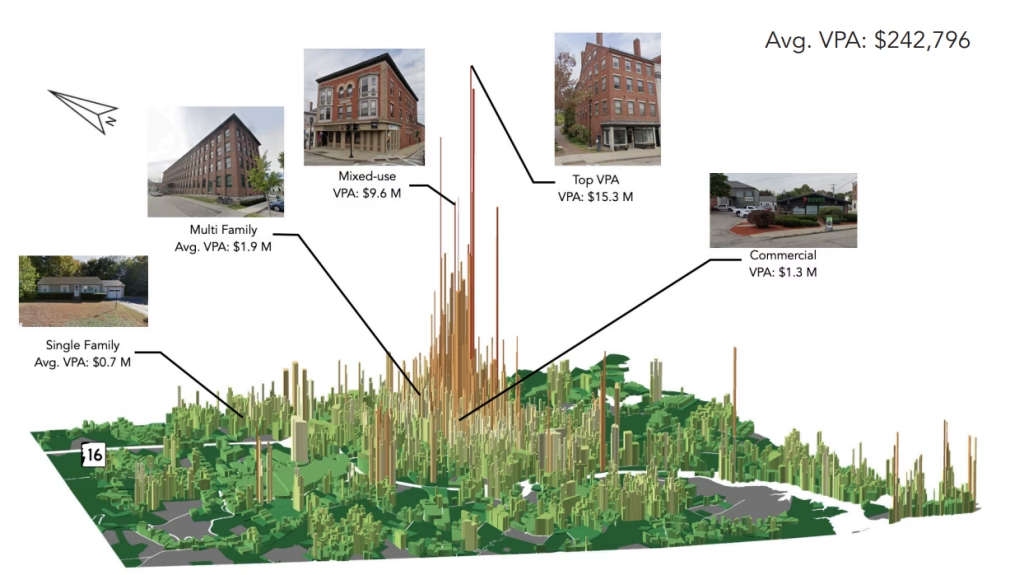
In 2020, Urban3 analyzed New Hampshire communities using the same value per acre metric (since communities have a finite amount of land to develop and generate revenue from) to better understand the relationship between municipal revenues and land use decisions. Urban3’s research demonstrated that New Hampshire municipalities generate their revenue from denser development in downtown corridors. Given that our tax system focuses on the assessed value of the development on the land – rather than the land value – high-value development such as multi-family or mixed-use development generates significantly more property tax revenue for a municipality than single-family or vacant land.
When you combine the high value per acre from mixed-use and multi-family development with the net value per home analysis from the Homes to Classrooms study, you can see how development drives municipal revenue growth.
The image below shows Dover’s value per acre. The trends shown in this map are replicated in communities all throughout the state.
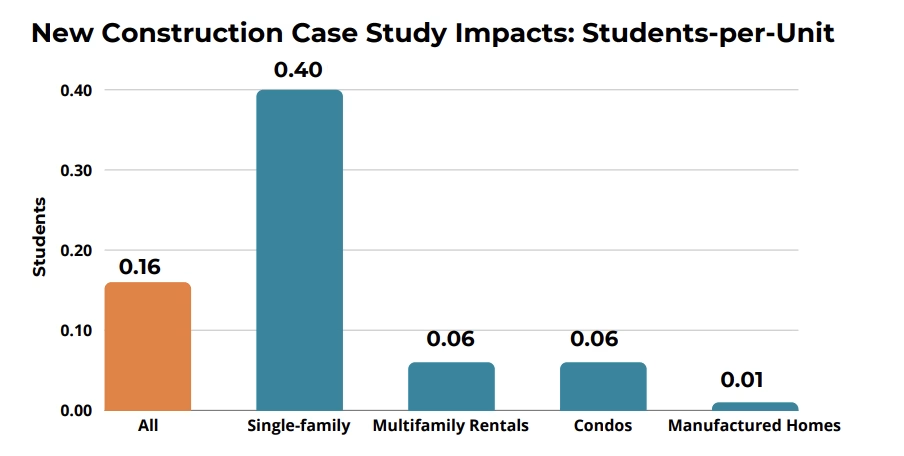
The school children myth. The net value per home figures outlined in the New Hampshire Housing’s From Homes to Classrooms study factors in the education costs, but let’s take a closer look into the figures. In New Hampshire, new construction generates, on average, .16 students per home. If a 100 home development was built in your community, you would expect to see 16 new students in the district. Those new students would be distributed across multiple grades.
The student per home rates vary depending on the type of housing. Multi-family rentals only generate .06 students per home while single family homes generate .40 students per home.
In 2019, University of New Hampshire Economics Professor Richard England set out to answer the question “Will More Kids in Town Raise the Local Tax Rate?” His research found that there is no correlation between more kids and local property tax increases. This is because the vast majority of education costs are fixed costs (building, energy, salary, benefits, etc.) which do not materially change when additional kids are added to a school district. It’s possible fringe cases of extreme growth could impact the fixed costs; however, that is outside of New Hampshire’s existing or projected development patterns.
Affordable housing projects pay property taxes. When below-market-rate projects are proposed by non-profit developers, there is often the misperception that they do not pay property taxes. This is not true. In addition to the public good of providing housing to our vulnerable friends and neighbors, and key members of our workforce, affordable housing projects are assessed by local property assessors. They either enter into a payment in lieu of taxes agreement (RSA 72:23-n) with the municipality or pay property taxes like other properties in town. In the 2025 legislative session, SB 173 updated the assessment formula for Low Income Housing Tax Credit projects to add clarity and predictability to the assessment process.
As communities around New Hampshire make difficult budget decisions and plan for their future, it’s critical that policymakers understand what healthy communities need and the impact of their decisions. The data is clear: smart development creates vibrant communities and generates revenue, making it a true win-win.