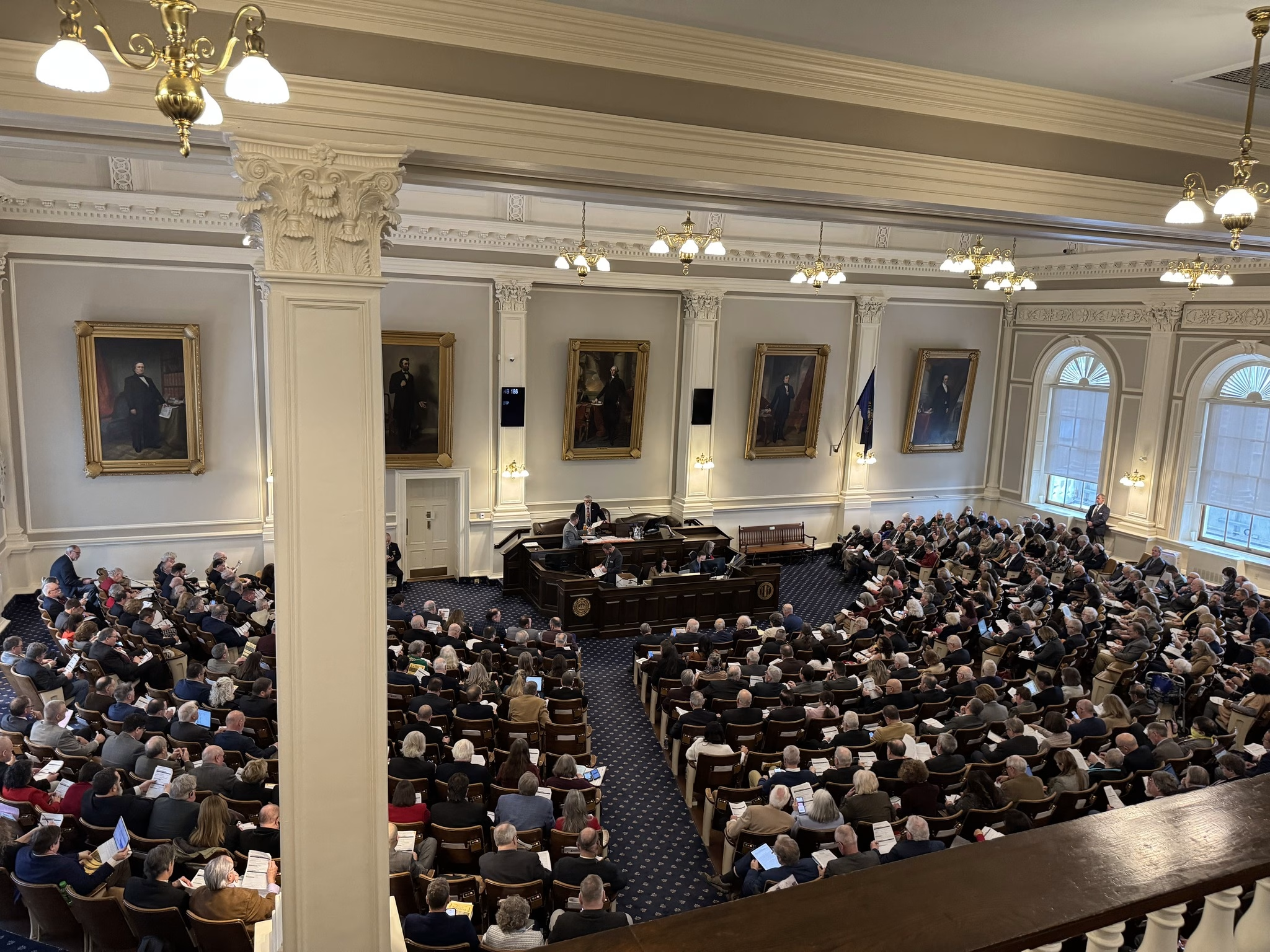
* As a reminder, the legislative office building is closed for renovations. All House committee meetings will be held at 1 Granite Place (South Building), Concord, NH. You can find directions and general information here. *
House Housing Committee: Tuesday, January 13th, Granite Place, Room 231
9:00 a.m. — HR 30, finding that planning, zoning, and related regulations have been and should continue to be the responsibility of municipal government.
- What It Does: This resolution finds that planning, zoning, and related regulations have been and should continue to be the responsibility of municipal government.
- Why It Matters (or Doesn’t): House resolutions are non-binding, so there is little practical impact of HR 30; however, Granite Staters have made it abundantly clear that they want their local, state, and federal officials to do everything they can to bring housing prices down. Declaring that the state doesn’t have a role in planning is putting ideology ahead of delivering for the people of New Hampshire.
- Housing Action NH Position: Oppose
9:30 am — HB 1098, relative to municipalities denying building or occupancy permits for property adjacent to class VI roads under certain circumstances.
- What This Does: This bill repeals the 2025 changes to the Class VI road statute and replaces it with a local governing body review.
- Why It Matters: Class VI roads are not maintained by a municipality, so, in most cases, there is relatively little development opportunity on these roads; however, its possible that certain Class VI roads are appropriate for development and this proposal would return state law to the more restrictive 2024 statute.
10:00 am — HB 1005, repealing the commission to study the historical evolution of the New Hampshire zoning enabling act.
- What It Does: This bill repeals the bipartisan commission contained in 2024’s HB 399.
- Why It Matters: The commission is tasked with studying the historical evolution of New Hampshire’s Zoning Enabling Act and providing legislative recommendations to the Governor and legislative leadership on November 1, 2026. Any recommended legislation would still need to advance through the formal legislative process. This commission provides a transparent, bipartisan, and knowledgeable forum for this important discussion.
- Housing Action NH Position: Oppose
10:30 a.m. — HB 1006, relative to on-site parking requirements for accessory dwelling units.
- What It Does: Currently, ADU parking may be provided either on-site or at a legally dedicated off-site location, at the property owner’s discretion. This proposal shifts the parking discretion from the property owner to “as approved by the municipality”.
- Why It Matters: This increases regulatory barriers to establish appropriate parking locations. It also requires “the municipality” to approve the arrangement, which typically refers to the entire town legislative body (ie. at a town meeting).
- Housing Action NH Position: Oppose
11:00 a.m. — HB 1007, relative to manufactured housing.
- What It Does: This proposal repeals the existing manufactured housing law and replaces it with weaker protections.
- Why It Matters: Manufactured housing is a great form of attainable home ownership. Any efforts to further restrict where manufactured housing is allowed will have a negative impact on housing affordability.
- Housing Action NH Position: Oppose
11:30 a.m. — HB 1008, relative to modifying innovative land use controls, requirements, and appeals.
- What It Does: Updates the innovative land use control statute to allow municipalities to require affordable housing units for project approval.
- Why It Matters: Mandatory, unfunded inclusionary zoning – while potentially well-intentioned – has proven to have a negative impact on housing construction. In municipalities around the country where mandatory inclusionsary zoning has been implemented, there are fewer homes built, leading to more scarcity and higher costs. Portland, Oregon, has experimented with funded inclusionary zoning, using a model that provides property tax relief to offset the cost of the affordable units, which has mitigated the decrease in overall housing construction. If you are interested in reading about Portland, OR’s model, you can do so here and here.
- Housing Action NH Position: Oppose
1:00 p.m. — HB 1009, relative to municipal parking requirements for residential units.
- What It Does: This bill reverts the ability of municipalities to regulate the number of parking spots required for new development to 2024’s HB 1400. HB 1400 said that a municipality could not require more than 1.5 parking spaces per unit for studio and one-bedroom units under 1000 sq ft that qualify for workforce housing and multi-family developments with 10 or more units. This would repeal 2025’s SB 284, which created a clear one spot per unit requirement.
- Why It Matters: Overburdensome parking requirements drive up housing costs, limit the amount of homes that can be built, and create seas of pavement. Nothing in SB 284 prohibited a developer or homeowner from building more parking. The policy question isn’t whether we need parking. It’s who should be making the decision about how much parking is necessary?
- Housing Action NH Position: Oppose
1:30 p.m. — HB 1010, relative to residential development on commercially zoned land.
- What It Does: Repeals 2025’s HB 631, permitting residential building in commercial zoning with a specific focus on retail (like aging strip malls) and office space.
- Why It Matters: One of the signature achievements of the 2025 legislative session, HB 631 enables the development of denser, mixed-use downtowns and the conversion of commercial-only buildings to residential use. Mixed-use development is an important tool not only in the housing toolbox but also provides the flexibility necessary to better use existing infrastructure.
- Housing Action NH Position: Oppose
2:00 p.m. — HB 1011, repealing zoning restrictions on dwelling units.
- What It Does: Repeals 2025’s HB 457, prohibiting a town from preventing two people from sharing a bedroom and prohibiting a town from policing the relationship between people occupying a house.
- Why It Matters: Several New Hampshire municipalities had ordinances restricting the number of people who may occupy a bedroom or how many unrelated people may share a home. As nontraditional family structures become more common and seniors (and others) explore co-living strategies to save housing costs, these laws can limit housing options. Underutilization of the existing housing stock also contributes to housing demand. This does not override life safety occupancy provisions.
- Housing Action NH Position: Oppose
2:30 p.m. — HB 1012, repealing accessory dwelling units and detached accessory dwelling units.
- What It Does: Repeals not only 2025’s HB 577 that allowed homeowners to build detached accessory dwelling units, but also the provision of law that has allowed homeowners to build attached accessory dwelling units since 2017.
- Why It Matters: If this bill passes, municipalities could ban accessory dwelling units from being constructed, decreasing future housing options.
- Housing Action NH Position: Oppose
3:00 p.m. — HB 1016, eliminating the requirement that municipalities allow for manufactured housing development opportunities.
- What It Does: Repeals the 1983 law that enabled manufactured homes to be installed in New Hampshire.
- Why It Matters: If this bill passes, municipalities could ban manufactured homes from being installed, decreasing future housing options.
- Housing Action NH Position: Oppose
3:30 p.m. — HB 1017, relative to accessory dwelling units and workforce housing.
- What It Does: This proposal allows municipalities to require ADUs meet the state definition of workforce housing or affordable housing.
- Why It Matters: The vast majority of ADUs are built and managed by individual homeowners looking for additional income or a place for family members to live. By requiring that ADUs meet affordability standards, individual property owners would have to income-verify any tenant, including family members, or risk legal penalties. If tenants earned beyond the allowable income, they would need to be evicted. This would lead to fewer ADUs being constructed in New Hampshire and would negatively impact housing availability.
- Housing Action NH Position: Oppose
Executive session on pending legislation may be held throughout the day, time permitting, from the time the committee is initially convened. The House Housing Committee will meet again on Tuesday, January 20th, and Thursday, January 22nd. The legislative proposals being heard on January 20th are posted here, and those being heard on January 22nd are posted here. We will provide an analysis of those bills next week.
Senate Election Law and Municipal Affairs Committee: Tuesday, January 13th, State House Room 122-123
9:15 a.m. — SB 435, relative to the zoning board of adjustment variance criteria.
- What It Does: Removes the requirement that in order to be granted a variance by the local zoning board of adjustment (ZBA), an applicant proves that literal enforcement of the ordinance would results in a substantial hardship.
- Why It Matters: ZBAs are quasi-judicial boards and make a ruling when a property owner is seeking to do something that is not currently allowed within the municipality’s zoning ordinance. Current state law spells out the five criteria that you need to establish before granting a variance: (1) The variance will not be contrary to the public interest; (2) The spirit of the ordinance is observed; (3) Substantial justice is done; (4) The values of surrounding properties are not diminished; and (5) Literal enforcement of the provisions of the ordinance would result in an unnecessary hardship. This proposal would make it easier for variances to be granted.
- Housing Action NH Position: Support
9:30 a.m. — SB 436, relative to zoning board of adjustment membership criteria.
- What It Does: Updates the ZBA conflict of interest and recusal statute to include: “A conflict of interest shall include any circumstance in which the member’s impartiality might reasonably be questioned…”
Senate Executive Departments and Administration Committee: Wednesday, January 14th, State House Room 103
10:00 a.m. — SB 490, establishing a task force to assess the development of housing at Great Bay community college and authorizing the college the right to use vacant property for the purpose of developing housing.
- What It Does: The bill establishes a task force to study housing feasibility, funding mechanisms, operational models, and resident support systems. This bill also authorizes the development of housing on the Great Bay community college property within the Pease development area, in coordination with relevant state agencies.
- Why It Matters: This would open up additional land for housing opportunities.
- Housing Action NH Position: Support
Senate Ways and Means Committee: Wednesday, January 14th, State House Room 122-123
9:00 a.m. — SB 471-FN, relative to affordable housing investment fees
- What It Does: Authorizes municipalities to adopt affordable housing investment fees for projects that don’t meet affordable housing requirements creating a payment in lieu of affordability requirement.
- Why It Matters: While likely well-intentioned, unfunded inclusionary zoning policies have had a negative impact on housing production when implemented elsewhere, leading to greater scarcity and higher costs. This proposal allows for a payment in lieu of affordable housing, which could mitigate some of the negative impacts of inclusionary zoning. However, there are no guidelines on the fees a municipality could charge in place of affordability, and many communities do not have an operating housing trust fund that could productively finance affordable housing with the proceeds that may be collected if this bill were implemented. Portland, Oregon has experimented with funded inclusionary zoning, using a model that provides property tax relief to offset the cost of the affordable units, which has mitigated the decrease in overall housing construction. If you are interested in reading about Portland, OR’s model, you can do so here and here.
- HANH Position: Oppose/Monitor
Tuesday, January 20th. The Senate has scheduled hearings on the following housing-related bills for the week of January 19th. We will have an analysis of these bills next week.
- SB 415, relative to a certain exemption in interest in condominium units.
- SB 564, prohibiting certain municipal development restrictions.
- SB 523-FN, establishing the registration and oversight of builders.
- SB 419-FN-A, relative to the housing champion designation and program and the affordable housing fund, and making appropriations therefor.