
BLOG: Low-Wage Workers Need to Work 3 or 4 Full-Time Jobs to Afford A Two-Bedroom Apartment
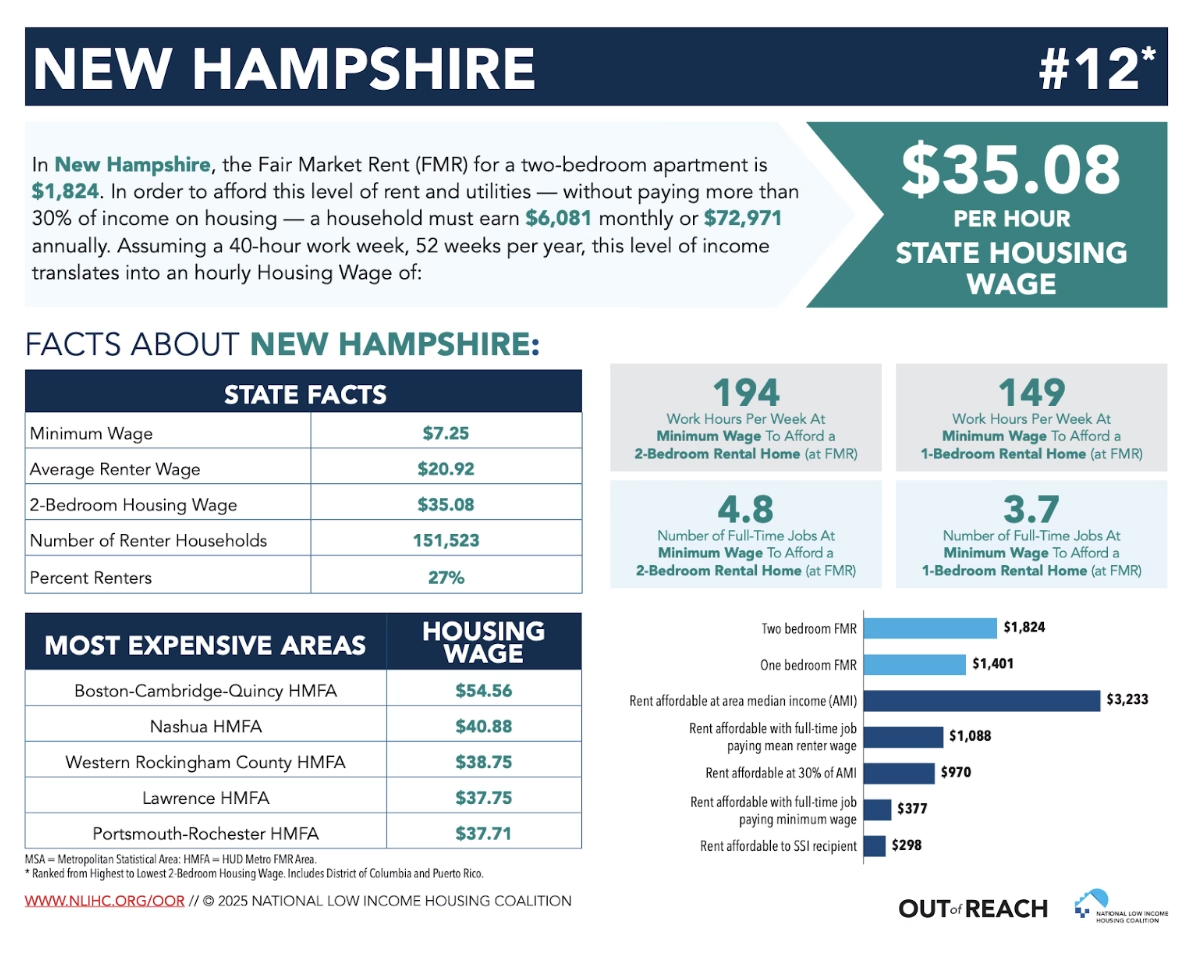
Full-time workers need to earn $35.08 per hour to afford a modest, two-bedroom apartment at Fair Market Rent in New Hampshire. According to the National Low Income Housing Coalition, the Housing Wage in New Hampshire is $35.08 – that means low-wage workers would need to work 3 or 4 full-time jobs to afford a two-bedroom apartment.
This is New Hampshire’s “2025 Housing Wage” according to Out of Reach, a report published jointly today by the National Low Income Housing Coalition (NLIHC) and Housing Action New Hampshire. The report’s release comes after the conclusion of New Hampshire’s state legislative session, which ended with progress on regulatory reform but a disappointing lack of investment to shore up financial tools and programs to support affordable housing.
“This is simply unsustainable. While the state legislature continues to make progress, there is much more to be done, and we must protect the critical HUD programs currently under attack,” said Nick Taylor, Director of Housing Action NH.
Out of Reach is an annual report that documents the gulf between wages and what people need to earn to afford their rents. The report’s “Housing Wage” is an estimate of the hourly wage full-time workers must earn to afford a rental home at HUD’s Fair Market Rent without spending more than 30% of their incomes. In 2025, the national Housing Wage is $33.63 per hour for a modest two-bedroom rental home and $28.17 for a modest one-bedroom rental home.
In New Hampshire, the Fair Market Rent (FMR) for a two-bedroom apartment is $1,824. In order to afford this level of rent and utilities – without paying more than 30% of income on housing – a household must earn $6,081 monthly or $72,971 annually. Assuming a 40-hour work week, 52 weeks per year, this level of income translates into an hourly Housing Wage of $35.08. Granite Staters would need to work 194 hours per week at minimum wage to afford a 2-bedroom rental home.
Significant disparities between what renters earn and their housing costs leave their housing security especially precarious during periods of economic uncertainty. Out of Reach 2025 sheds light on how recent economic downturns have led to long-term increases in the prevalence of housing cost burdens among the lowest-income renters. Housing cost burdens prevent low-income renters from affording other basic necessities and also keep them at constant risk of housing instability.
“Housing is more than just a shelter; it is foundational to well-being and dignity,” said NLIHC President and CEO Renee Willis. “This year’s Out of Reach report shows that, despite economic gains for some, low-income renters continue to face impossible choices between paying rent and meeting basic needs. Cutting federal housing investments would only deepen the crisis. Congress must protect and expand housing programs that ensure stability, opportunity, and a pathway out of poverty for millions of renters.”
https://nlihc.org/oor/state/nh