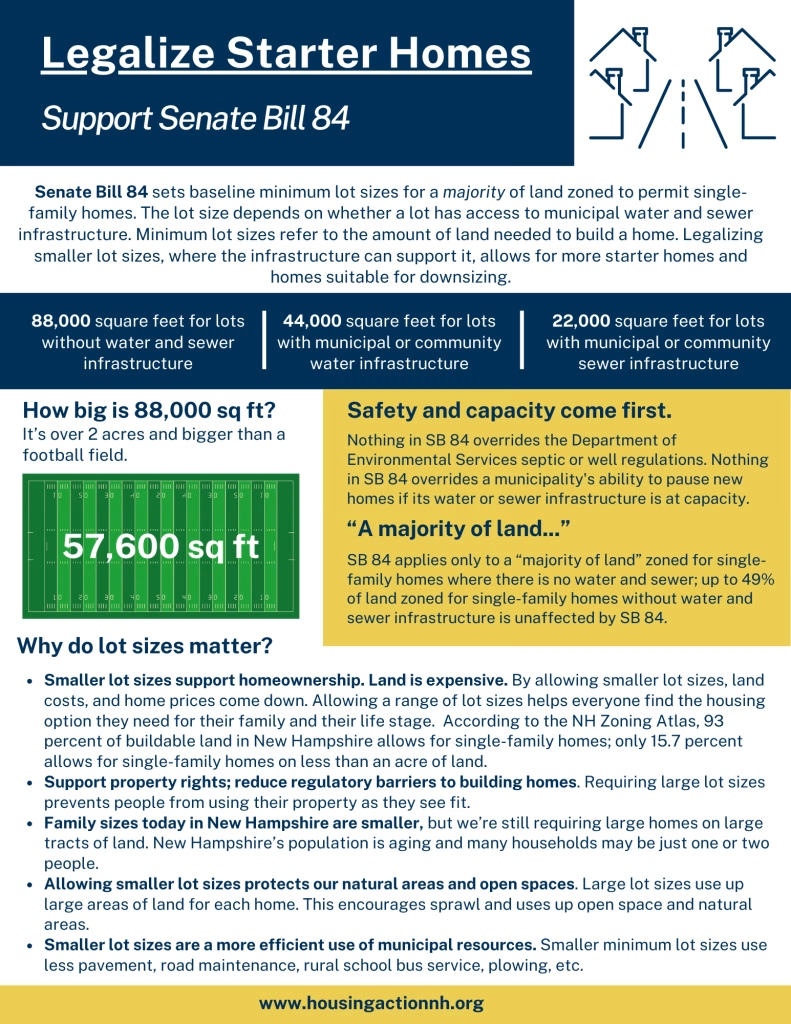
How many football fields do you need before you can build a home? In many New Hampshire communities, the answer is two or three football fields worth of land before you can build a home. Zoning rules that require single-family homes to be built on these huge parcels—even when smaller lots would be perfectly viable– drive up costs making starter homes and those suitable for downsizing difficult to build. That’s where Senate Bill 84 (SB 84) comes in. What SB 84 Does: SB 84 sets baseline minimum lot sizes for the majority of land zoned for single-family homes, scaling those sizes depending on the availability of municipal water and sewer: - 88,000 sq ft if no water/sewer infrastructure is available
- 44,000 sq ft if there is a public or community water supply
- 22,000 sq ft if there is public or community sewer
SB 84 does not override the Department of Environmental Services’ regulations or a municipality’s authority to pause new construction if water or sewer capacity can’t support additional homes. Why Lot Sizes Matter - Promotes Homeownership: Smaller lot sizes lower land costs, making it easier to build affordable “starter homes” or enable older residents to downsize without leaving the community.
- Supports Property Rights: Large-lot zoning limits what property owners can do with their land. Reducing lot-size minimums ensures more flexible use of one’s property.
- Today’s Changing Family Size: Households in New Hampshire are smaller—often just one or two people—yet many towns still require large homes on large tracts of land.
- Preserve Open Space: Smaller lots reduce the amount of land taken up by each home, limiting sprawl and conserving natural areas.
- Saves Tax Dollars: Infrastructure like roads, plowing, and utilities can be more efficiently maintained when lots are kept to a reasonable size.
Bottom Line SB 84 is about legalizing smaller lots in places where infrastructure already exists to support them. By doing so, we can address rising housing costs, offer more housing options for different life stages, and protect open spaces. It’s a straightforward change that will provide more housing options for Granite Staters. (Note: This post was updated on 4/11/25 to reflect the Senate passed floor amendment setting the baseline lot size in a majority of land without water and sewer infrastructure to 88,000 sq ft. — up from the original 66,000 sq ft.) |